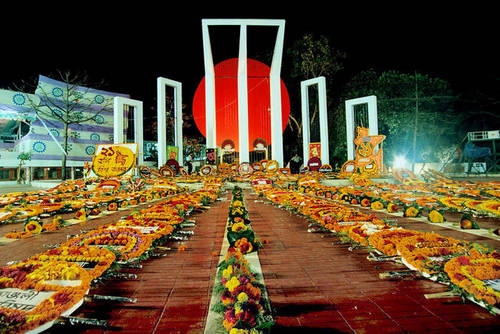
History of Ekushe February...
February 21st day commemorates the lives sacrificed to make Bengali one of the national languages when Bangladesh was part of Pakistan. The West Pakistani regime tried to force Urdu as the national language, a fact that was strongly contested by Bengali's. On that fateful day a procession by Bengalis was shot at by police resulting in the death of 4 martyrs. The nascent Bengali nationalism ultimately gave birth to the free nation of Bangladesh.

Martyrs day. This February 21st day commemorates the lives sacrificed to make Bengali one of the national languages when Bangladesh was part of Pakistan. The West Pakistani regime tried to force Urdu as the national language, a fact that was strongly contested by Bengali's. On that fateful day a procession by Bengalis was shot at by police resulting in the death of 4 martyrs. The nascent Bengali nationalism ultimately gave birth to the free nation of Bangladesh.
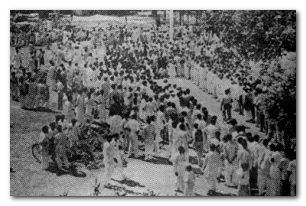
The Pakistan government imposed section 144 (gatherings of more than 4 people prohibited). The students fighting for Bangla's right decides to break the law.
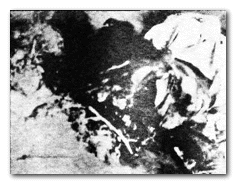
Shaheed Rafique felled by indiscriminate firings by the police on the student procession.
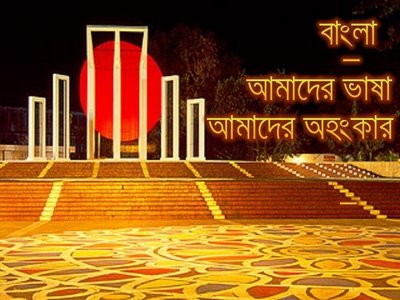
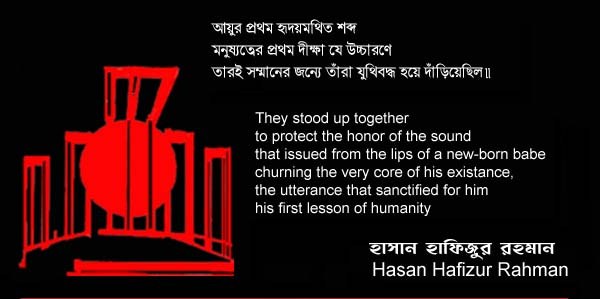
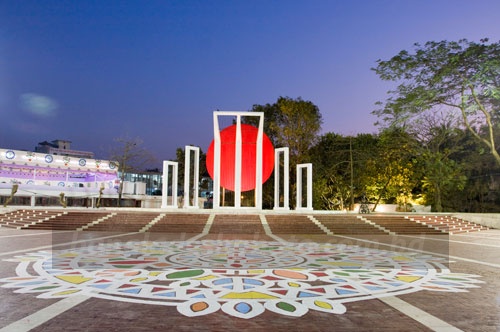
The memorial built to commemorate the language martyrs.
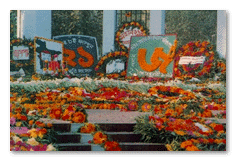
Every February 21, people from all walks of life walk barefoot to the Minar and lay wreaths of flowers to commemorate the martyrs.
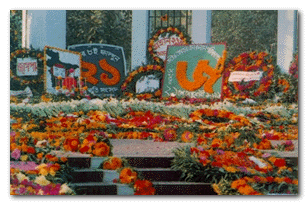
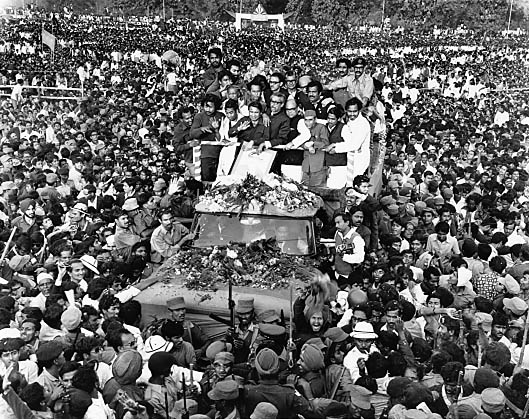
Another scene from February 21, 1991
A Brief History of the Bangla Language Movement
Mohammad Bari. 1998, All rights reserved.
1st Wave
- September 15, 1947
- Tamuddun Majlis (Cultural Society, an organization by scholars, writers and journalists oriented towards Islamic ideology) in a booklet titled State Language of Pakistan : Bengali or Urdu? demands Bengali as one of the state language of Pakistan.
- The Secretary of the Majlis, at that time a Professor of Physics in Dhaka University, [Abul Kashem] was the first person to convene a literary meeting to discuss the State Language issue in the Fazlul Huq Muslim Hall, a student residence of Dhaka University. Supporters and sympathizers soon afterwards formed a political party, the Khilafate-Rabbani Party with Abul Hasim as the Chairman. (-- Talukder Maniruzzaman)
- November 1947
- In Karachi, the representatives of East Bengal attending the Pakistan Educational Conference, called by the Minister of Education Fazlur Rahman, a Bengali, oppose Urdu as the only national language.
- February 23, 1948
- Direndra Nath Dutta, a Bengali opposition member, moves a resolution in the first session of Pakistan's Constituent Assembly for recognizing Bengali as a state language along with Urdu and English.
- The resolution "... was opposed by Liakat Ali, the Prime Minister of Pakistan and other non-Bengali members in the Assembly. Regrettably, this was opposed by Khawaja Nazimuddin - hailing from the eastern wing - and a few other Bengali collaborators of the West Pakistanis in the Assembly. Later, D. N. Dutta came up with a few amendments to the original resolution, and everytime these were opposed by the west Pakistanis and their Bengali stooges. The West Pakistanis were uncompromising to such a genuine demand of the majority Bengalis." (-- Rafiqul Islam)
- "The demand for Bengali as one of the state language gathered the spontaneous support of the Bengali Civil Servants, academics, students, and various groups of middle class. Several members of the Provincial Assembly, including some ministers, were reportedly active in supporting the movement. By the end of February 1948, the controversy had spilled over on the streets. The East Pakistan Student League, founded in the first week of January by Mujibur Rahman, was in the forefront of the agitation." (-- Hasan Zaheer)
- March 1948 (1st week)
- A Committee of Action of the students of Dhaka University, representing all shades of opinion - leftists, rightists, and centrists - is set up with the objective of achieving national status of Bengali.
- March 11, 1948
- Students demonstrating for Bangla as state language is baton-charged and a large number of students are arrested in Dhaka.
- " The situation grew worse in the days that followed. The Quaid-i-Azam was due to visit Dhaka from 19 March. The provincial government became nervous and Nazimuddin under pressure of widespread agitation, the impending visit of the Governor-General, sought the help of Muhammad Ali Bogra to enter into negotiations with the Committee of Action. An agreement was signed by Nazimuddin with the Committee which, inter alia, provided that (1) the Provincial Assembly shall adopt a resolution for making Bengali the official language of East Pakistan and the medium of instruction at all stages of education; and (2) the Assembly by another resolution would recommend to the central government that Bengali should be made one of the state languages." (-- Hasan Zaheer)
- March 21, 1948
- Mohammad Ali Jinnah, the founder of Pakistan and its first Governor-General, while on a visit to East Bengal, declares in Dhaka University convocation that while the language of the province can be Bengali, the "State language of Pakistan is going to be Urdu and no other language. Any one who tries to mislead you is really an enemy of Pakistan."
- "The remark evoked an angry protest from the Bengali youth who took it as an affront: their language Bangla (Bengali) was, after all, spoken by fifty-four percent of the population of Pakistan. Sheikh Mujibur Rahman, then a university student, was among those who raised the protest slogan and was placed under detention. The Dacca University campus became the focal point for student meetings in support of the Bangla language." (--Siddiq Salik)
- Jinnah meets the student representatives of Committee of Action to persuade them of the necessity of having one national language, but the students are not convinced.
- "The discussion of Jinnah with the student representatives could not bear any fruit but blurred the difference between the student group led by Sheikh Mujibur Rahman and his associates and the student group led by Shah Azizur Rahman. The National leadership resorted to repressive policies in order to crush the Bengali language and put its supporters behind bars." (-- Md. Abdul Wadud Bhuiyan)
2nd Wave
- January 26, 1952
- The Basic Principles Committee of the Constituent Assembly of Pakistan announces its recommendation that Urdu should be the only state language.
- In a public meting at Paltan Maidan, Dhaka, Prime Minister Nazimuddin declares that Urdu alone will be the state language of Pakistan.
- Both the developments spark off the second wave of language agitation in East Bengal.
- January 28, 1952
- The students of Dhaka University in a protest meeting call the Prime Minister and the Provincial Ministers as stooges of West Pakistan.
- January 30, 1952
- In a secret meeting called by the Awami League, which is attended by a number of communist front as well as other organizations, it is agreed that the language agitation can not be successfully carried by the students alone. To mobilize full political and student support, it is decided that the leadership of the movement should be assumed by the Awami League under Bhashani.
- January 31, 1952
- Bhashani presides over an all-party convention in Dhaka. The convention is attended by prominent leaders like Abul Hashim and Hamidul Haq Choudhury. A broad-based All-Party Committee of Action (APCA) is constituted with Kazi Golam Mahboob as Convener and Maulana Bhashani as Chairman, and with two representatives from the Awami League, Students League, Youth League, Khilafate-Rabbani Party, and the Dhaka University State Language Committee of Action.
- February 3, 1952
- Committee of Action holds a protest meeting in Dhaka against the move 'to dominate the majority province of East Bengal linguistically and culturally'. The provincial chief of Awami League, Maulana Bhashani addresses the meeting. On the suggestion of Abul Hashim it decides to hold a general strike on 21 February, when the East Bengal Assembly is due to meet for its budget session.
- February 20, 1952
- At 6 p.m. an order under Section 144 of the Criminal Procedure Code prohibiting processions and meetings in Dhaka City is promulgated.
- This order generated tension and resentment among the students.
- February 21, 1952
- A general strike is observed.
- Noon - A meeting is held in the campus of Dhaka University. Students decide to defy the official ban imposed by Nurul Amin's administration and processions are taken out to stage a demonstration in front of the Provincial Assembly. Police starts lobbing tear gas shells to the students. Students retaliate by batting bricks. The ensuing riot spreads to the nearby campuses of the Medical and Engineering colleges.
- 4 p.m. -The police opens fire in front of the Medical College hostel. Five persons - Mohammad Salauddin, Abdul Jabbar, Abul Barkat, Rafiquddin Ahmed and Abdus Salam - are killed, the first three are students of Dhaka University.
- "The news of the killing spread like wildfire throughout the city and people rushed in thousands towards the Medical College premises." (-- Talukder Maniruzzaman)
- Inside the assembly, six opposition members press for the adjournment of the House and demand an inquiry into the incidents. But Chief Minister Nurul Amin urges the House to proceed with the planned agenda for the day. At this point all the opposition members of the Assembly walk out in protest.
- February 22, 1952
- Thousands of men and women throng the university, Medical College and Engineering College areas to offer prayers for the victims of the police firing.
- After prayers when they go for a procession, the police opens fire.
- The police also fire on angry mob who burned the offices of a pro-government newspaper. Four persons are killed.
- As the situation deteriorates, the government calls in the military to bring things under control.
- Bowing to the pressure, the Chief Minister Nurul Amin moves a motion recommending to the Constituent Assembly that Bengali should be one of the state language of Pakistan. The motion is passed unanimously.
- "For the first time a number of Muslim members voted in favour of the amendments moved by the opposition, which so far had consisted of the Hindu Congress members only. The split in the Muslim League became formalized when some members demanded a separate bloc from the Speaker; the Awami (Muslim) League had attained the status of an opposition parliamentary party." (-- Hasan Zaheer)
- February 23, 1952
- A complete general strike is spontaneously observed, despite the resolution by the Provincial Assembly. The government again responds with repressive measures.
- APCA decides to observe a general strike on February 25 to protest the government's actions.
- The students of Medical College erect overnight a Shahid Minar (Martyr's Memorial) at the place where Barkat was shot to commemorate the supreme sacrifices of the students and general population. Shahid Minar later became the rallying symbol for the Bengalis.
- February 24, 1952
- The government gives full authority to the police and military to bring the situation in Dhaka back to normal within 48 hours.
- "During these 48 hours the police arrested almost all the student and political leaders associated with the language movement." (-- Talukder Muniruzzaman)
- February 25, 1952
- The Dhaka University is closed sine die.
- "In the face of these repressive measures, the movement lost its momentum in Dhaka. But it spread widely throughout the districts ... In addition to demands for recognition of Bengali as one of state languages of Pakistan, students now began to call for the resignation of the 'bloody' Nurul Amin cabinet ... Nurul Amin claimed that the government "had saved the province from disaster and chaos" by its repressive measures. The students, however, argued that they had already "written the success story of the movement on the streets with their blood." In retrospect, whatever the merits of government and student actions, it is clear that the movement did sow the seeds of a secular-linguistic Bengali nationalism in east Bengal. Its immediate impact was to prepare the ground for the complete routing of the Muslim League in the 1954 elections by a United Front of opposition political parties, on a nationalistic planck of cultural, political and economic autonomy for East Bengal." (-- Talukder Maniruzzaman)
- "The Language Movement added a new dimension to politics in Pakistan. It left deep impression on the minds of the younger generation of Bengalis and imbued them with the spirit of Bengali nationalism. The passion of Bengali nationalism which was aroused by the Language Movement shall kindle in the hearts of the Bengalis forever ... Perhaps very few people realised then that with the bloodshed in 1952 the new-born state of Pakistan had in fact started to bleed to death." (-- Rafiqul Islam)
Results
- May 7, 1954
- The Pakistan government recognizes Bangla as a state language.
- Feb 26, 1956
- The Constituent Assembly passes the first Constitution of Pakistan recognizing Bangla as a State Language.
- March 23, 1956
- The first Constitution of Pakistan comes into effect.
- March 26, 1971
- Bangladesh become an independent nation.
Sources
- Hasan Zaheer, The Separation of East Pakistan - The Rise and Realization of Bengali Muslim Nationalism, Oxford University Press, Karachi, Pakistan, 1994
- Talukder Maniruzzaman, The Bangladesh Revolution and its Aftermath, Bangladesh Books International Ltd., Dhaka, Bangladesh, 1980
- Siddiq Salik, Witness to Surrender, Oxford University Press, Karachi, Pakistan, 1977
- Rafiqul Islam, A Tale of Millions, Ananna, Dhaka, Bangladesh, 3rd edition, 1986
- Md. Abdul Wadud Bhuiyan, Emergence of Bangladesh and Role of Awami League, Vikas Publishing House, Delhi, India, 1982
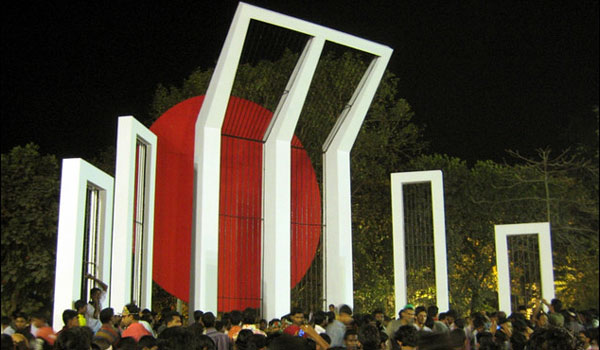
The 21st of February has been a day of national mourning, pride, reflection and action. It was also the Language Martyr’s Day. It is 60 years ago on this day that among others, Barkat, Rafiq, Jabbar, Shafiur and Salam sacrificed their young precious lives for honour and preservation of mother language, Bangla.
It has been a day of pride for all people of Bangladesh, that the supreme sacrifice made on this day in 1952 has eventually led to the recognition of preservation of mother languages worldwide. Only in 1954, the United Front government of Abu Hussain Sarker declared a public holiday for this day.
This Day has become a milestone in recognition of the right to speak, promote and preserve all mother languages across the world.
International Mother Language Day:
At the initiative of Bangladesh government, it was 17th November 1999, the Paris-based United Nations Educational, Scientific and Cultural Organisation (UNESCO) adopted 21st February as the International Mother Language Day. For the first time, UNESCO observed 21st February, 2000 as the International Mother Language Day.
Scottish historian and essayist Thomas Carlyle (1795-1881) called the language “the body of thought”. This implies that if a mother tongue is crushed, thoughts and ideas will inevitably die.
About 6,912 mother languages are thought to exist today. But social, demographic and political factors are all contributing to possible disappearance of about 2,500 languages. Of the 2500 languages, 196 in India, 192 in the US, and 147 in Indonesia, are likely to disappear, according to a report of UNESCO.
Furthermore 199 languages are spoken by a few. For example, the language, Middle Chulym, now spoken by a handful in Siberian townsfolk (45 in number), has integrated into Russian language and once the last fluent speaker dies, the language will be extinct.
What is lost when a language is lost is another world, according to many language experts, valuable ethnographic and cultural information disappears when a language dies, leaving a gap in the understanding of the variable cognitive structures of which human brain is capable.
A Brief history of Language Movement:
On February 23, 1948 in the Pakistan Constituent Assembly in Karachi, Dhirendranath Dutta, a member of the Pakistan Constituent Assembly, made a speech calling for Bengali to be made one of the official languages of Pakistan. He stated as follows:
“I know, Sir, that Bengali is a provincial language, but, so far our state is concerned, it is the language of the majority of the people of the state. So although it is a provincial language, as a language of the majority of the people of the state it stands on a different footing. Out of six crores and ninety lakhs [69 million] people inhabiting this State, 4 crores and 40 lakhs (44 million) of these people speak the Bengali language. So Sir, what should be the State language of the State of Pakistan? The State language of the State should be the language which is used by the majority of the people of the State, and for that, Sir, I consider Bengali language the lingua franca of our State.”
However, .in 1948 on 19th March, Pakistan’s Governor General Mohammad Ali Jinnah, popularly known as Quaid-e-Azam, claimed at a gathering of students of Dhaka University that Urdu should be the only state language of Pakistan, ignoring the fact that Bangla is the mother tongue of 56% of the people of Pakistan.
Meanwhile in 1950, students formed the “Bangla State Language Action Committee” and worked tirelessly to make Bangla one of the state languages of Pakistan.
The immediate starting point of the tragedy of 21st February is that on 27th January, 1952, the then Prime Minister of Pakistan Khwaja Nazimuddin announced at a public meeting that Urdu alone should be the state language of Pakistan.
The students were infuriated at the announcement because Nazimuddin as chief minister of East Bengal in 1948 signed an agreement with the leaders of ‘Rashtrabhasa Sangram Parishad (State Language Action Committee) with a commitment to adopt a resolution of having Bangla as the other state language of Pakistan by the provincial Assembly. Many members of the Committee were non-students, such as, Professor Abul Kashem, Kamruddin Ahmed, (later Ambassador), Mohammad Toaha, Naimuddin Ahmed (later Advocate) and Abdur Rahman Chowdhury (later a Judge of the High Court).
It may be mentioned that subsequently students of the Dhaka University and Dhaka Medical College took a robust role in the cause of the Language Movement and took a crucial decision and defied the wishes of politicians to violate Section 144 (prohibiting an assembly more than five persons) on 21st February, 1952. . The then political leaders did not want to destabilize the political situation by lending support to students to violate Section 144 to delay general election in East Bengal, (later East Pakistan, now Bangladesh)..
On 21st February, 1952, agitated unarmed students of Dhaka University, violated Section 144 in protest, to proceed to the elected members of the East Bengal Legislative Assembly ( near SM Hall) and present their demand to Nurul Amin, the Chief Minister.
On their way at the site of the Medical College students’ hostel number 12, at 3-30 PM, the police opened fire on the peaceful procession of students by an order of a Magistrate (a West Pakistani).
Jabbar and Rafiq died on the spot, while three others died later in hospital ( an impromptu monument had been set up by Medical College students on the site of the current Shaheed Minar ) It is believed that many more were killed including a ten year old boy, but their bodies were taken away by the police and were secretly buried. The rest is history.
Bangla language & Book Fair:
Of all the languages in South Asia, Bangla is the first to develop a literature of a very high order and still holds the model for other languages. Bangla language is unique in the sense that it has many varieties of ways to describe an object. For example, in English an “eye” has only one expression to describe but in Bengali an “eye” can be described more than one way (akhi, nayan, chok, padmalochon etc).
Bangla writers in the past and present have enriched the language by transfusing Sanskrit, Persian, Arabic and English languages in it. Bangla was raised to its highest fame by Rabindranath Thakur (Tagore) when he was awarded in 1913 the Nobel Prize for Literature.
Every one in Bangladesh has a right to read and write Bangla, and unless free adult education for all ages of people with free learning equipment and school dress for poor children are provided, the purpose of the sacrifice of Bangla language will be defeated.
One educationist suggested that students from high school to university are to be engaged during their holidays to take one village in their charge to make all the villagers literate. Such a movement by students and literate village youth can easily turn into a literacy campaign under the government and NGOs. Within a few years all Bangladesh will be literate.
It is good to note that during the last two years, free text books are provided to all students and drop out from primary schools of poor students before secondary school stage has been reduced due to effective incentives for retention of students.
Many suggest language is a living thing and must be relevant for all people. Bangla Academy and educationists may convene a conference to discuss, debate and arrive at a decision of simplification and easy to make Bangla language access to all people in the country.
Bangla Academy may consider the following: First, the grammar of Bangla language needs to be simplified. Second, some alphabets of Bangla need to be revisited as to whether all alphabets are necessary or not. Third, the spelling of Bangla is to be made easy and practical for writing. Fourth, monitoring in schools and training for correct pronunciation of Bangla words for teachers in schools may be undertaken.
Another fact we must not forget that learning of Bangla does not mean that we do not learn other languages, especially English. Multi-lingual skill is an asset for every one and English has turned into a language of trade and commerce.
Since 1979, the Ekushey February Book Fair was held at the Bangladesh Academy premises. This year, like last year, the book stalls are set up in spaces close to Bangla Academy.
Prime Minister Sheikh Hasina inaugurated the fair on 1st February. As many as 360 publishing houses and institutions including Dhaka Metropolitan Police have set up book stalls at the Fair. According to Bangla Academy, a total of 169 new books of different publications hit the fair on the third day and last year 3,600 books were displayed at the Fair. It is reported that number of visitors to the Fair is on the rise and reading habits are on an upward curve.
For readers, the price of Bangla books has become very expensive because the printing paper and other materials are costly. The government may consider in exempting tax and custom duties on printing paper and other materials so as to make books easily available to readers at an affordable price. A knowledge- nation does not grow automatically. It needs to be carefully developed and nurtured.
Another matter to be considered by the Academy is whether the book fair can be held in various parts of the Dhaka metropolitan city for access to all. Traffic jam is one of the hurdles to attend the Book Fair at the Academy from all parts of the city, besides standing for a long queue to enter the Fair.
Finally, 21st February is more than a language movement for people of Bangladesh. Many historians think 21st February laid the seed of the foundation of a separate state of Bangladesh on the basis of Bengali nationalism that was aptly summed up by Bangabandhu Sheikh Mujib when he said: “I am Bengali, my nationalism is Bengali.” The Constitution as amended last year in its Article 6 (2) describes “the people of Bangladesh shall be known as Bangalees as a nation and the citizens of Bangladesh shall be known as Bangladeshis.”
Barrister Harun ur Rashid, Former Bangladesh Ambassador to the UN, Geneva.
Prime Minister Sheikh Hasina inaugurated the fair on 1st February. As many as 360 publishing houses and institutions including Dhaka Metropolitan Police have set up book stalls at the Fair. According to Bangla Academy, a total of 169 new books of different publications hit the fair on the third day and last year 3,600 books were displayed at the Fair. It is reported that number of visitors to the Fair is on the rise and reading habits are on an upward curve.
Thursday 3pm 21st February 1952 The alphabet bleeds

|
|
|
The fight between the students and the police forces went on and on. But the situation reached its darkest phase when, around 3 pm, a group of armed police, instructed by district magistrate Koreshi, sprang out from behind the shop opposite to Dhaka Medical College hostel and took position in the hostel ground and opened fire. Some bodies fell on the streets, streaming blood dyed the roads with crimson hue. Some precious young lives turned into Bangla alphabet. In the tear gas afflicted murky ground of Dhaka University the fight between the cops and students went on unaware of the great sacrifice of human lives, first in human history, for the defense of the mother tongue.
Despite brutal firing and tear gas attack, the police could not occupy the medical college hostel. The students kept them at bay by throwing bricks. Soon the news of police shooting the students spread like thunderbolt. Life in Dhaka turned into a standstill. Thousands of people streamed into the Dhaka medical hospital to pay their tribute to the martyrs. Shocked and grief-struck their face turned stone, amber in their hearts.
The bodies of the dead and the injured were taken to the Dhaka medical hospital. Doctors and nurses rushed into the emergency department to save their lives. One of the bodies was unidentifiable because the head was blown away. Later it was identified as martyr Barkat’s dead body. Mourning became the East Bangla.
Later that evening the dead bodies were taken to the morgue. As the police snatched few unidentified dead bodies from the teargas afflicted public earlier that afternoon, the students, fearing that the police might try to do it again, guarded the morgue gate. But in the dead of the night, a group of armed commando troops, escorted by the police, stormed the morgue gate and forcibly took the dead bodies at the gun point. But a few die-hard students followed the military jeeps on foot and watched them dumping the dead bodies in the nearby Ajimpur cemetery. As soon as the army left the cemetery, the students came out of their hidings and marked the spots where the martyrs were dumped. The following morning thousands of people went to the cemetery and paid their tributes to the martyrs of Bangla language movement.

The First Shahid Minar
The Bangla language movement was essentially conceived and led by the Bangalee students. Since this movement onwards, students’ role in the national politics has been central. Unlike the political parties, the students’ movement always won the indiscriminate sympathy and support of the masses. In the language movement the roles of the politicians were insignificant (many top political leaders including Sheikh Mujib were imprisoned before the movement). They could not direct the students’ emotions and passions for nationalist political achievements. The Bangalee intelligentsia (the secular and liberal intellectuals, most of them were black listed by the Pakistani authority and brutally murdered by the collaborators of Pakistan army, the Razakars, Al-Badard and other militant Islamic fundamentalists just a week before the independence. Please visit Liberation War, Martyr Intelligentsia, Razakars and War Criminals pages for details) had a great contribution in this movement. Conservative parties like Muslim League, Jamat and other Islamic parties always opposed, and even tried to crash, the nationalistic movements. After independence, all the major political parties, whether democratic or military, tried to politicize the Bangla language day. The traditional morning rallies to the language monument are often disrupted by the fight between the opposing political parties to place the photos of their party leaders on the top of the monument. Islamic parties always opposed the Bangla Language Day and tried to persuade the Muslims from rallying and offering flowers to the Shaheed Minar (Martyrs’ Monument) by interpreting it as idol worship. Even in some areas where the Jamatis dominate, they attempted to destroy the monuments. Despite all the mean politics about the language movement and its legacy, Ekushay February will forever inspire the Bangalees to defend and love their sweet mother tongue- Bangla.